Showing posts with label geometry. Show all posts

Monday, November 5, 2018

5 Expert Activities for Teaching Surface Area

       Surface area and volume can be so confusing for kids, but this year I set of activities that really helped my students understand these concepts.  When I gave my kids a quiz over surface area and volume (mostly of rectangular prisms), they really did a fantastic job!  Here's what I did. 

  • Activity 1:  The first activity had students build arrangements of rectangular prisms using 12 interlocking cubes.  Then they had to make a net for at least one of the rectangular prisms.  I really think this was an important place to start.  6th grade standards expect students to learn about finding surface areas from nets, but I know that my students needed to review this foundational skill.  This activity was a good place to start, but I also know that I didn't want to spend toooo much time having students build prisms.  Let's face it, after a day, I was already tired of telling my kiddos to stop building everything else but rectangular prisms.   
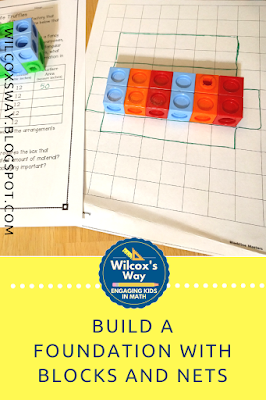
    In this volume and surface area activity, students used blocks to build a prism and then made a net for it.

  • Activity 2:  I think the next activity that I did was the key to my kids understanding surface area and volume so well this year.  I made up rectangular prisms of varying sizes and set them up at stations around the room.  For each station, I had students list out the following information:
    • Dimensions of the prism
    • Dimensions of top
    • Dimensions of front
    • Dimensions of side
    • Total volume (which I described as the number of cubes needed to build the figure)
    • Total surface area (which I described as the number of stickers needed to cover the stickers)  
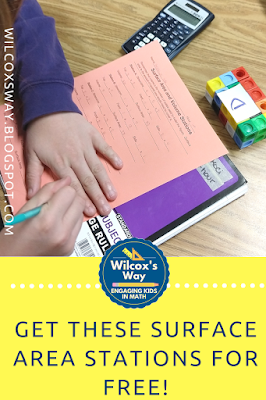
      Students working with rectangular prisms to find surface area and volume.
This truly was class time well spent.  Students really began to understand how surface area and volume were different and started to understand how to find the surface area.  At the end of this day of stations, I showed students the formulas for volume and surface area of rectangular prisms, and they really made sense to them!  Click here or the picture above to get a copy of these stations!

  • Activity 3: The next activity that we did was a card sorting activity where students had to match 6 different types of cards:  picture of the prism with lines, a picture of the prism without lines, dimensions, net of the figure, volume calculations, and surface area calculations.  The card sorting activity, as well as the activity described in activity 1, are available in my Teacher's Pay Teachers store.     
    Card sort with cards containing volume, dimensions, surface area, and nets.
  •  At this point, my kids understand the concepts pretty well and they just needed PRACTICE!  So we spent half of a class one day practicing, and that did wonders.  
  • Activity 4:  Next, it was time to work on triangular prisms.  I started by giving kids a worksheet of triangular prisms that were made on graph paper.  I thought it was important to start this way because it gave students a chance to see how to make the prism and see the measurements. This only took about 15 minutes, so I was able to combine activities 4 and 5 into one day in class.
  • Activity 5:  Next, we moved on to nets of triangular prisms, but ones that listed measurements instead of showing the net on graph paper.  Then we practiced drawing each of these figures as they would look when they were folded up.  With each one, we talked about each of the sides of the net and where it would be on the 3-D version.  I think this really helped my students be able to break down a 3-D figure into its parts.  In fact, on my quiz, I saw some students redrawing the 3-D triangular prisms into nets.

       At this point, I gave a quiz that had surface area and volume of rectangular prisms and surface area of triangular prisms.....and the kids TOTALLY rocked it!  It was a quiz that was actually fun to grade because even my often struggling students were doing really well.  Yay!!!

      For my class, the next step is an activity to help students generalize the volume formula.  I look forward to planning this, but at this point, I'm feeling super excited about the progress we have made so far.


Thursday, January 11, 2018

Easy Solutions for Teaching Angle Relationships

        One of our first units of the year is Shapes and Designs.  Part of this unit involves teaching angle relationships, such as complementary and supplementary angles.  As with any topic, there are a few things that can cause issues for students when learning about angle relationships.

      Issue 1:  Remembering the vocabulary.  One pretty obvious issue is that students have to remember the definitions of complementary and supplementary.  I have a pretty effective (although geeky) way that I help my students remember this.
      For complementary angles, I ask my students, "You all like compliments, RIGHT?".  At first they look at me confused.  Then I ask again, and I start to get a lot of  "I see what you did there" kind of nods as students realize way I said RIGHT so loud!  So this becomes a mantra in our class for a week or two.       

Fun way for your students to remember complementary angles.


     Now if you thought complementary was a geeky way to remember, hold your socks....supplementary is even better!  :)  For supplmenetary, I tell my students that I'm going to introduce a new "mathematical" way of greeting one another.  You walk up to someone, with both arms held straight out (the straight line in supplementary angles) and say "WSUP?".   At this point, I get quite a few groans and eye rolls, but as I walk in to class for the next couple of weeks, I will be greeted by a chorus of WSUPs!

Get silly and help students remember the difference between complementary and supplementary angles


     Issue 2:  Understanding what the vocabulary means.   This issue was less obvious to me at first.  I was working with a student at study hall, and he could tell me the definitions of complementary and supplementary, but he couldn't do much else related to complementary and supplementary angles.  At first, I was struggling to figure out the problem.  Finally, after telling me what complementary meant, I told him to draw me a picture of what complementary angles looked like.  This kid looked at my like I had grown another head!  In all of our work with complementary and supplementary angles, the pictures had been provided.  When I had him draw his own set of angles, a light bulb went on and he really made that connection to what the definition really meant.  The longer I teach, the more I realize that having students create or even just visualize their own models of situations is very powerful, rather than always providing them for them.

     Issue 3:  Arithmetic errors.  Now this one is pretty silly, and pretty easily corrected....but can we just take a moment and groan for all of the times that my students told me that the complement of a 32 degree angle would be 68 degrees.   Students rush and forget to borrow when they subtract.  The good news here is that usually a simple question like, "So 32 + 68 is 90?" and students quickly realize the mistake.

     Issue 4:  Setting up the equations.   I had a few students that could easily find the complement or supplement, but going from that to a problem with an equation was difficult.

I found that having the student repeat the definition, and then use their own words to frame a question was really helpful.  It would go something like this:
                    Me:  Are these complementary or supplementary?
                    Student:  Complementary
                   Me:  What does complementary mean?
                   Student: Two angles that add up to 90.
                   Me:  So what two things add up to 90 in this picture?
For many of my students, this was enough to help them make the connection and set up the equations.

     Issue 5:  Understanding what the answers meant.   When we started working with equations, many students were confused about solving for the variable in equations like above, and the actual measure of the angle.  We had many class discussions about this, and I made it a practice to ALWAYS ask for both the value of the variable and the measure of the angle.

What issues have you had with angle relationships, and how did you help your students?  Comment below!

If you need some stations, notes or games to teach angle relationships, click here to see what I have in my TpT store.  There's a free angle relationships golf game, as well lots of other stuff!


Thursday, December 7, 2017

The Best Math Christmas Project Ever

    Ok, this will be a short post.....but I just have to tell you how excited I am about my classroom Christmas tree this year.


     We decided on a 3:1 ratio of green pyramids to other colored pyramids for the "decorations".

     I'm excited.  The kids are excited.   What a win-win!  And it's been pretty easy.  The only supplies I've needed are colored copies of a net for a triangular prism and tape.  One day for my warm up, I reviewed the surface area and had every kid fold up one pyramid.  And that is the only class time I've taken to do this.  The rest was kids taking these home to work on, or kids that wanted to work during our advisor/homeroom time at the end of the day.

     I will definitely do this again next year.  I think one thing I will change is that I will use the chance to more fully review surface area and make kids draw the height in on the base of the pyramid.  Then I'll have them find the surface area.  I'll probably also give them 10 minutes or so to decorate their pyramid, but you wouldn't have to do that.

Patterns.  Geometry.  Math.  Art.  Beauty.  Creativity.  Christmas Decorations.  It's perfect!

Students decorate triangular pyramids and put them together to make a math Christmas tree.


Update:  When I did this last year, I just used a basic pattern for a triangular pyramid printed two per page.  This year, I'm going to make it a bit fancier.  I have several patterns for students to use.  Some of them have clip art that kids can color.  One pattern reviews area of triangles and has students find the surface area of the pyramid.  One pattern focuses on acts of kindness and one focuses on different things about the student.  I think I will have each kid make two of these....one of their choice and then everyone will do the area of triangles one.    I'm also excited that I think I have the other 7th grade teachers on board to do this as well, so I think we will be able to take this to the "next level" and have an even bigger tree!

Use triangular pyramids to build a math Christmas tree pyramid.

       It's easy to do this project with a simple triangular pyramid that you can easily find with a Google search.  Click here for a video tutorial explaining how to put the pyramids together.  If you'd like the patterns shown above, click here to see this at my Teachers Pay Teachers store.