Showing posts with label STEM. Show all posts

Saturday, August 11, 2018

Expert Teacher Tips for STEM Challenge Success

       Hopefully, after my last post you're excited to try a STEM challenge in your math classroom.....but maybe you're still a little nervous?  Have no fear!  Here are my top tips for successfully implementing STEM challenges in your classroom.

1.  Try it yourself first
I know you may not be that excited about building a house from marshmallows and toothpicks or whatever the challenge is, but it really is helpful in many ways.  It helps you understand different routes that students may take (although you'll still have students surprise you with something you didn't think of).  You will also better understand what roadblocks students might hit, giving you a better idea of how to help them get "unstuck" without giving away too much.  I also think it is great to build rapport with students, as you can commiserate with them about the problems you had.  And maybe, just maybe, you'll have some fun once you get started!   My son and I have had quite a bit of fun trying out my STEM ideas!

A boy trying to build a structure out of toothpicks and candy in a STEM challenge.


2.  Consider materials carefully
This can be a helpful consideration both in choosing the STEM challenge, as well as how you implement it.  Before you choose a STEM challenge, carefully consider the materials.  If the materials don't seem like a good fit for your class, keep looking for a different challenge.  You might also consider what materials you want to make available.  For many STEM challenges, students are allowed to choose materials, so look over that supply list with a critical eye.  Make thoughtful decisions about materials you don't want to use, or additional materials you want to make available.  Here are some of the factors that affect my materials choice:
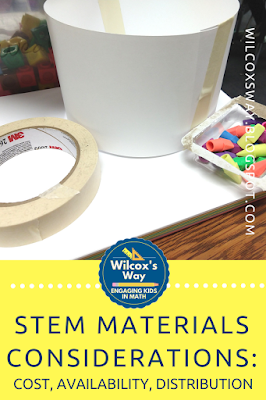
  • Are they affordable in the amount I will need?
  • Are the materials easy to find?  
  • Are they easy to store after finished?  
  • Can I save the extras for later use?
  • Can my students handle using them appropriately?
  • Am I going to be left with a mess?
Carefully consider materials when implementing a STEM challenge


3.  Consider materials distribution carefully 
Make sure you think this through before you start.  Disorganized materials distribution can sour the whole experience for you, so take the time to plan this carefully so it won't drive you crazy.
  • Are you going to give all students a set of the exact same materials?  
  • Are you going to set out the materials and give students free access?  
  • Will there be one person in the group that is in charge of getting materials for the group?  
  • If students have extra materials, should they return them immediately or at the end of the challenge?  
  • Can students get materials whenever they are ready, or will you call groups to get materials one at a time?
4.  Consider group size carefully
There is no perfect group size for STEM challenges.  The perfect size depends on what students are being asked to do.  Think carefully about how many students can be actively involved in the challenge.  The perfect group size for STEM challenges (and almost anything!) is one where you have enough people to do the work and get ideas, but not so many that people get uninvolved.  One of my STEM challenges involves students building a scoop for cereal.  For this one, I like to use pairs.   Two people are plenty to design a scoop and measure the contents.  For a different STEM challenge where students are building a pool large enough to land a high diver, I like larger groups.  There is more to do during testing, so larger groups make more sense.


5.  Consider the best timing to incorporate any math you want to work into the challenge
If part of your purpose for the STEM challenge is for students to incorporate a math concept, think carefully about whether it will be more effective before or after the challenge.  For one STEM challenge that I did, students had to build a structure that had a base with a particular area.  In that case, it was important that students had a strong foundation regarding square inches and area before they started.  In another case, students were graphing inequalities on a number (showing that all acceptable results were below a particular value).  In this instance, I chose to teach graphing inequalities on a number line after we did the STEM challenge, as I felt that students would have greater buy-in with their own data to use.  

6.  Decide in advance how you will hold students accountable
Personally, I like to begin and end every STEM challenge with students working individually.  After I pose a STEM challenge, I always give students a few minutes to write down their thoughts about the challenge before they begin work with their group.  This holds students accountable, but also means that when groups begin working together, every student should have ideas to contribute.  I end every STEM challenge with students reflecting about the how successful their group was and how well they worked together.  Your accountability may look different, but I would definitely encourage you to have each student be responsible for something on their own.

7.  Decide what you want students to do when they finish
Your classroom is going to be a busy place, and the last thing you need is groups of students wandering around, messing with students that are still working.  Make sure that students know what to do when they are done.  This is a great time for students to reflect on their group work, or to do some math that goes along with their challenge.  You will also want to make sure that students take time to clean up their area.

Tips for Success with STEM Challenges are given in this post.


8.  Accept that your classroom is going to be louder than normal when you do a STEM challenge
If you know to expect this, it is a little easier to accept.  For me, I have grown to love this aspect of STEM challenges (within reason 🙂).  I love to hear the excitement in my students' voices as they explain to a group member their idea.  I love to hear their cheers when they finally get something to work after many tries.  I love that students are having fun and learning, so I have learned to accept the noise!
tips for successful stem challenges


Now that you have this information, I encourage you to give STEM challenges a try.  Comment below and tell what you tried and how it went.

Saturday, July 21, 2018

Reasons I Get Excited About STEM Challenges in Math

       STEM activities are all the rage, and my goal for this year is to make time for one STEM challenge each quarter this year.  I'll be honest, I'm fairly new to the STEM bandwagon.  Prior to 2016, I hadn't done any STEM challenges and I really had no plans to incorporate STEM in my classroom.  I figured that I had enough on my plate just trying to teach all of the stuff that was in my standards.

       That all changed in the summer of 2016 when I was privileged to attend Honeywell Educators at Space Academy.  Space Camp helped me realize that I not only need to teach my kids math skills.  I also need to help them see the exciting things that STEM can open up for them.  I need to help my students see themselves as people who are capable of using math as a tool solve problems.  So began my experience with STEM challenges.

     Over the last couple of years, I've found some STEM activities that really fit my needs.  This year, I plan to do a STEM challenge every quarter.  I've become a STEM challenge enthusiast, and here are the reasons why I love STEM challenges.

1.  STEM challenges are a great way for kids to really see the real world applications of math.  Let's face it....our textbooks try to use story problems to accomplish this task, but they are often not successful.  The contexts in story problems are often too contrived to make students care about them.

Graph shows a pie chart of math story problems being about food, coins, races and more.

The beauty of a STEM challenge, however, is that you are giving students a problem to solve.  As they complete the challenge, math can be one of the tools that they use to find and gauge their success.

2.   STEM challenges are a place to really show the need for precise measurements.  Measurement of a variable is often the key to determining success in a STEM challenge.  If the challenge is to build the tallest pipe cleaner tower, accurate measurement is definitely a key.  In other STEM challenges, students must stay within given constraints.  For example, if you are only allowed to use 6 square inches of foil in your product, you will need to measure accurately for this.

3.  The need for correct labels is clear.  I was doing a STEM challenge last year where students had to build a shelf to hold as many quarters as possible.  They were given limitations for the size of the shelf, such as less than 6 square inches.  This STEM challenge really exposed my students' misunderstandings about the difference between inches and square inches.  Even better, it gave me a way to address this misunderstanding at a time that my students needed to know that information.

4.  STEM challenges are a great chance to introduce students to the power of spreadsheets.   STEM challenges often involve data collection, and this is a good way to incorporate the technology part of STEM.  Spreadsheets are a great way to collect the data. What a great way to introduce students to the power of a spreadsheet than with a bunch of data that they collected!  Last year we did a STEM pipe cleaner challenge, and there were so many excited students when I showed them that they could enter the calculations once and the spreadsheet could do all of the calculating for them.   In the real world that we live in, much of the math that we need can be automated with a spreadsheet.  It is so important for students to begin to see that math isn't always about doing the calculations yourself, but sometimes about knowing how to get a computer to do them for you!

5.  STEM challenges are a great way to work on a variety of math concepts.  Many STEM challenges involve measurement, data collection, and data analysis.  For many STEM challenges, however, the math part stops with these things.  However, I've found ways to incorporate many other topics:

  • Area, surface area, and volume:  STEM challenges often involve creating some object, so I've found that I can often incorporate area, surface area or volume.  I did a STEM challenge last year where students had to build a diving pool for a daredevil high-diver (pencil cap erasers!).  After the challenge, students had to find the surface area and volume of their pool to see who had the pool with the least surface area.
  • Percent change:  This works especially well if you give students a chance to improve their original creation.  For example, lots of STEM challenges involve students building tall towers.  I've seen these with spaghetti and marshmallows, pipe cleaners, cups, or even balloons!  To incorporate percent change, have the students complete the original project and measure their tower.  Then give them time to make revisions, or wait until another day and have them try again.  Then students can compare the percent change between the first and second attempt.
  • Ratios:  I did one STEM challenge where students had to build a tower from candy and toothpicks.  The catch was that they were assigned a particular ratio of candy to toothpicks that they had to use. 
  • Equations and inequalities:  I've found there are often ways to incorporate equations and inequalities into a STEM challenge.  Let's say your STEM challenge is for students to build a tower that is at least 12 inches tall.  Why not use this to introduce the idea of writing inequalities?  Or you could have all students put their tower heights on a number line, and introduce the idea of graphing inequalities.  When we built our candy/toothpick towers, we wrote equations relating the number of toothpicks to candy.
6.  STEM challenges are a great way to teach a growth mindset.  STEM challenges are all about trying things out and making adjustments to make things work better.   During a STEM challenge, it is no big deal to have something not work and try something different.  What a great opportunity for teachers to reinforce the power of learning from our mistakes to figure out better solutions or understandings.  I take any chance I can to reinforce the power of learning from our mistakes with my students.  


7.  STEM challenges are great for those random days that you don't know what to do with.  You know what I'm talking about....that 2 day week before Thanksgiving when you don't want to start something new.  Or that day when fourteen kids have the flu and you don't want them to miss the lesson that is such a foundation for your unit.  STEM challenges are great to fill in these random days, and yet still be focused on math.

8.  STEM challenges are great to engage all different kinds of students.  Kids love doing hands-on stuff and even my most reluctant math students will dive into a STEM challenge.
Pictures of students completing STEM challenges in a middle school math classroom.


9.  They're fun!   We get so worried about teaching standards and finishing everything that sometimes the fun gets lost.  It's nice to hear the fun and excitement of a STEM day!  It's nice to hear kids in the hall talking about how much fun math is today.  It's nice to have kids still talking about something you did in class a week later.

10.  STEM challenges are a great way to get kids collaborating.  I always have my students work in groups on STEM challenges.  STEM challenges are a great way to get kids exchanging ideas, and incorporating ideas from many students.  This is a great way to work on "soft skills"!

Shows a STEM challenge set up and  math assignment that goes with it.

What is your favorite STEM activity to do in math class?  Comment below!


Tuesday, February 6, 2018

Ideas for Celebrating Pi Day

     Pi Day is a day we all love as math teachers, right???  A chance to shine light on math in a fun way.  So here are some fun ways you could celebrate Pi Day this year. 


1.  Do a Pi Day Breakout.  Breakouts (like an escape room for the classroom) are lots of fun, and great to teach those "soft skills" we're always hearing about, like collaboration and perseverance.  A quick Google search for Pi Day Breakout turned up lots of free resources.  Here's a link to a digital Pi Day Breakout, but you can find more pretty easily!

2.  Play Rolling for Pi.   This quick game is a fun way to start things off for Pi Day, or something you could do if you just have a short time to celebrate.  I give each student a six-sided number cube.  Then I have everyone roll together, and you get to remain standing as long as you are rolling the digits of pi (in order!).  So on the first roll, only those kids that rolled a 3 would remain in the game.  Then they would roll again and try to get a 1, and so on.  The kid that rolls the most digits of pi is the winner.  This game works fine with 6-sided dice for the first several digits of pi (3.1415), and you could just declare anyone that got this far the winner.  Variations of this game include using 10-sided dice or having students create a spinner to use.

3.  Pi Day Puzzles.   I have a fun (FREE!) Pi Day Sudoku puzzle in my Teachers Pay Teachers store that would be fun.  There are two puzzles; one has Pi Day trivia, while the other other has students calculating problems with circumference and area of circles.

4.  Pi Day chain contest.  This is another great way to get kids working collaboratively.  Divide your class up into groups of 3-5 students.  Each group is supposed to make a paper chain with the digits of pi in the correct order.  The group with the longest chain of accurate digits in the time given wins.

5.  Pi Day Trivia.  Take a quick break and play some trivia.  My kids love to play trivia when we have a few extra minutes.  A quick Google search can find lots of free trivia.

6.  Pi Day STEM Challenge.  I'm going to have kids create the smallest circular "landing pool" for a daredevil to dive into.....but it has to be big enough for the daredevil to hit the pool 10 times in a row!  My "diving board" will be a ruler, and my "daredevil" will be a simple pencil eraser.  You can see the set up below.  After the kids create the pool, they have to find the surface area.  Click here if you're interested in full supporting materials for this lesson!

7.  Write a Pi Day story.  Want to get your English teacher involved in Pi Day?  Here's a fun one for them!  There are two ways to do this.  One way is to have kids write a "story"....the catch is that the word lengths in the story have to follow the digits of pi.  So you start with a 3-letter word, then a 1-letter word, etc...   Another variation, is to have the kids write a normal story, but they have to work in the digits of pi in order.  This one gets fun because words like "to" count as a two, and "won" counts as one.

8.  Make pie!!!   The science teacher on my team gets involved in the day by having the kids make a cream pie as a lab, using Bunsen burners.  We have parents donate ingredients, and have half the kids make chocolate cream pie and half make butterscotch cream pie.  Then of course, at the end of the day, we eat!

9.  Pi Day problem hunt.  Give your students a printout with one page of pi digits printed out.  Have them look for problems within the digits.  The problems can be simple (1 + 4 = 5) or more complicated ones using order or operations.


10.  Pi Day Hopping Races.   If you are able to take kids outside or to the gym, this one might be fun.  Have a race where students have to hop the digits of pi.  3 hops on one foot, 1 hop on the other foot, 4 hops on the other foot, etc....

11.  Pi Day Goose Chase.  Ok, I  have to admit that I haven't tried Goose Chase EDU yet.  It's like a digital scavenger hunt.  It looks super fun, though and I'm dying to try it some time.  Here is one I created that would work for Pi Day.  Click here to see the one I made.

12.  Pi Day Scavenger Hunt.  Speaking of scavenger hunts, a paper scavenger hunt is a more traditional option.  Last year my class had a great time with this.  I had pictures posted of all kind of circular objects with the radius or diameter labeled.  Their scavenger hunt list included things like "something edible with an area of 15" or "something hot with a circumference of 20 in".  The kids got a little creative with it, and it was fun!  Click here to get one that is ready to go from my TpT store..


Sunday, November 12, 2017

Celebrating National STEM Day by Putting the M in STEM

    November 8 was National STEM Day.  When a colleague came in my room a couple of days before that to ask what I was going to do for National STEM Day....I'll be honest.  My first thought was, "I'm so far behind my pacing guide....I can't afford to do ANYTHING!".  But as I sat and thought about it, I came to the same conclusion I've come to several times since attending Space Camp....my job is not only to teach kids math skills, but to inspire them to want to learn math.  My job is to show them that math could be a part of their future, and that it could be a good thing.


     So I decided that I would do a STEM activity, because my students needed that chance to be creative, and work collaboratively, and do so many other things that STEM can do in the classroom.  And I did work in some important math from my standards (even if it wasn't exactly what my pacing guide said I should be doing!).

     The challenge for my students this time:  To build a tower with a shelf at the top that could hold at least two quarters.  Students had a limited amount of "credits" to spend, and they got bonus points for unspent credits.  They also got bonus points if their tower could hold more than two quarters.  Each group had to draw three cards that guided their building.  The cards had inequalities that gave students criteria they had to meet for tower height, base area and shelf area.


      I don't know about your students, but in 7th grade, many of my students still struggle with inequality symbols.  There were many discussions throughout the day about the meaning of the cards.  "Does this mean our tower can be 5 inches, or does it have to be taller?"  "Does the area of the base have to be more or lesss than 6 square inches?"  "How big is 3 square inches?"  I find the open-ended activities like this are a great chance for formative assessment for me, if I listen to the students having conversations with each other.  For this lesson, I could definitely tell that many of my students didn't fully understand inequality symbols, as well as the difference between inches and square inches.

     After a short introduction, my students ended up with about 30 minutes to work on this STEM challenge.  That seemed to be just about the right amount of time.  Because students got extra points for unspent credits, they were very careful about material use.  That was one nice thing about this STEM challenge....the materials ended up being really cheap!  The things I had available were graph paper, index cards, tape, staples, straws, foil (cut in 2" squares) and pipe cleaners.

     My student creations were AMAZING!  I had one group that used a single piece of paper, and built a 5 inch tower that held 15 quarters.  I had groups in every hour that build towers so sturdy that 30 quarters wasn't enough to topple them (I realized in 1st hour that I had to put a limit on how many extra points they could get for sturdiness....one group of boys built a tower that held 5 huge library books and still hadn't toppled!).  Students were engaged, creative, and working hard....STEM for the win!

     The next day, I used this as a chance to teach kids how to graph inequalities on the number line.  In each class, I had a handful of students that remembered learning this in 6th grade, but the majority did not.  Using the cards from the STEM challenge, student quickly understood how to graph inequalities.   I feel like this made it well worth it to have take the time to do the STEM challenge.

If you're interested in this Inequality STEM Challenge lesson, you can get it at my TpT store.
   

Saturday, September 3, 2016

Where is Space Camp Taking Me?

           Space camp was such an amazing experience....one that I know will never be duplicated.  I can (and have) gone on and on about all of the awesome experiences I had at Space Camp, but as amazing as it was, I have to come back and make changes that my students can see for it to make a difference for anyone but me.  It can't just be a cool experience that I recount for them.  In some way I have to find my own way to bring that excitement to my math classroom.  
     Obviously this is not something that is accomplished overnight.  Almost three weeks into school, I want to pause and take a minute to think...how am I bringing Space Camp back to my classroom?  From day one, I have definitely shared my excitement with kids.....telling them about it, showing them pictures. 

 I wore my flight suit and talked about my newfound passion for space.  I showed them a video clip of Kennedy, talking about the going to the moon, "not because it is easy, but because it is hard".  We talked about setting goals worthy of being hard, and we've talked about where the US space program is now.
      But what else.....because that is not enough. I came away from Space Camp realizing I needed to help my kids see all the cool pathways that math and science could open up for them, rather than just teaching them math and hoping the inspiration comes from somewhere else.  
        So for the first time, I collaborated with the science teacher on my team to do a STEM challenge.  Last week, kids built pipe cleaner towers in science, and recorded the height. This week, kids repeated this activity in my class and recorded their tower height from science versus the second attempt in my class.  It took all of 20 minutes, and next week I have real data that the kids collected and that they care about available to use to talk about measures of center and measures of variability.
Kids hard at work.
Love this pic....shows that big smile while working!
   
We are also going to talk about percent change as we compare their trials.  For just 20 minutes of fun (and problem solving and collaboration), I have a great intro to teach all this stuff I needed to teach anyways.  Plus, I hope that activities like this will help bring in some of my kids that don't love math and don't think they're good at math....maybe things like this will crack the door open for a few students to find some enjoyment in math and science, that didn't have that before.  Because my winning groups weren't necessarily the kids that usually excel in math...but yesterday they did.  And they had fun at the same time!    If you're interested in the lesson plan for this from my store, click here.
This simple design was one of the tallest towers, at 53 cm.  The winning tower was 53.5 cm.

         This  STEM challenge is also a good time to introduce the kids to the new "teams" they will be working with for the rest of the quarter.  Instead of table 1,  table 2, and so on, I now have teams Harmony, Unity, Tranquility, Kibo, Zarya,and Columbus (Space Camp team names, after parts of the International Space Station).  One of the ambassadors at camp gave us this idea....make teams that cross over hours to build up the idea of teamwork.    Teams collected points for how their team placed in our pipe cleaner challenge. Who knows.....maybe there will even be a Commander's Cup to award the winning team (this is the award my team, team Columbus, won at camp).    
    
Team Columbus, with our Commander's Cup patches!

      Another awesome thing is that after doing this STEM challenge together, the science teacher and I already have several more things planned together.....investigating claims on GrowBeasts and Double Stuff Oreos, planning a Martian Day as our team day for the last day before winter break.  Plus more collaborative STEM challenges for us in future quarters!  I can't tell you how excited I am about all of these things, and I just know the kids will love it too!
     So this is where Space Camp has taken me so far, with high hopes for many more changes to come!

FYI:  My fantastic Space Camp adventure was possible because of my new favorite company, Honeywell, as I was part of Honeywell Educators Space Academy.  This amazing program paid my way to Space Camp, and applications are open now for next year!  If you teach middle school math or science, you should apply!!