Showing posts with label card sorts. Show all posts

Monday, November 5, 2018

5 Expert Activities for Teaching Surface Area

       Surface area and volume can be so confusing for kids, but this year I set of activities that really helped my students understand these concepts.  When I gave my kids a quiz over surface area and volume (mostly of rectangular prisms), they really did a fantastic job!  Here's what I did. 

  • Activity 1:  The first activity had students build arrangements of rectangular prisms using 12 interlocking cubes.  Then they had to make a net for at least one of the rectangular prisms.  I really think this was an important place to start.  6th grade standards expect students to learn about finding surface areas from nets, but I know that my students needed to review this foundational skill.  This activity was a good place to start, but I also know that I didn't want to spend toooo much time having students build prisms.  Let's face it, after a day, I was already tired of telling my kiddos to stop building everything else but rectangular prisms.   
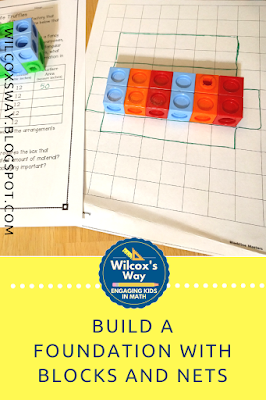
    In this volume and surface area activity, students used blocks to build a prism and then made a net for it.

  • Activity 2:  I think the next activity that I did was the key to my kids understanding surface area and volume so well this year.  I made up rectangular prisms of varying sizes and set them up at stations around the room.  For each station, I had students list out the following information:
    • Dimensions of the prism
    • Dimensions of top
    • Dimensions of front
    • Dimensions of side
    • Total volume (which I described as the number of cubes needed to build the figure)
    • Total surface area (which I described as the number of stickers needed to cover the stickers)  
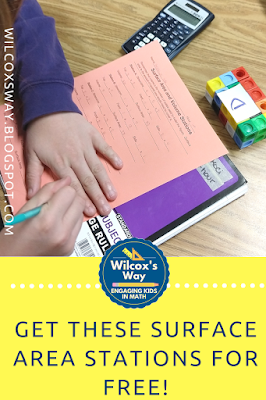
      Students working with rectangular prisms to find surface area and volume.
This truly was class time well spent.  Students really began to understand how surface area and volume were different and started to understand how to find the surface area.  At the end of this day of stations, I showed students the formulas for volume and surface area of rectangular prisms, and they really made sense to them!  Click here or the picture above to get a copy of these stations!

  • Activity 3: The next activity that we did was a card sorting activity where students had to match 6 different types of cards:  picture of the prism with lines, a picture of the prism without lines, dimensions, net of the figure, volume calculations, and surface area calculations.  The card sorting activity, as well as the activity described in activity 1, are available in my Teacher's Pay Teachers store.     
    Card sort with cards containing volume, dimensions, surface area, and nets.
  •  At this point, my kids understand the concepts pretty well and they just needed PRACTICE!  So we spent half of a class one day practicing, and that did wonders.  
  • Activity 4:  Next, it was time to work on triangular prisms.  I started by giving kids a worksheet of triangular prisms that were made on graph paper.  I thought it was important to start this way because it gave students a chance to see how to make the prism and see the measurements. This only took about 15 minutes, so I was able to combine activities 4 and 5 into one day in class.
  • Activity 5:  Next, we moved on to nets of triangular prisms, but ones that listed measurements instead of showing the net on graph paper.  Then we practiced drawing each of these figures as they would look when they were folded up.  With each one, we talked about each of the sides of the net and where it would be on the 3-D version.  I think this really helped my students be able to break down a 3-D figure into its parts.  In fact, on my quiz, I saw some students redrawing the 3-D triangular prisms into nets.

       At this point, I gave a quiz that had surface area and volume of rectangular prisms and surface area of triangular prisms.....and the kids TOTALLY rocked it!  It was a quiz that was actually fun to grade because even my often struggling students were doing really well.  Yay!!!

      For my class, the next step is an activity to help students generalize the volume formula.  I look forward to planning this, but at this point, I'm feeling super excited about the progress we have made so far.


Sunday, March 12, 2017

4 Wins Teaching Integers This Year

     I just finished teaching my integers unit this year, and overall I'm  really pleased with how things went.  The kids overall did pretty well, and some of my kids that struggle sometimes really hit this one out of the park!

     I've been trying to reflect on what I did this year that set my students up for success, and here are some of the things that I think helped.
integers-number-lines-formative-assessment


1.  Number lines, number lines, number lines
      We used them a lot!  One of the very first lessons in our Accentuate the Negative unit is a unit based on the number line.  It focuses quite a bit on looking at opposites on the number lines, and comparing which of two numbers are farther from zero.
     This year, I decided it was a great day to get kids moving.  So instead of doing the lesson out of the book, we did the lesson on a human number line.  I set our pieces of construction paper numbered from -5 to 5, and gave each of the kids an index card with a number on it.  Some of the numbers were integers, some fractions, and some decimals.  Then I called up 3-4 kids at a time to find their "spot" on the number line.  Once the kids were on the number line, I started asking the same types of questions that were in the lesson in the book: Who is farther from zero?  How do we know that Robbie and Ashley are opposites?  Where would Zoie's opposite stand?  Whose number is largest and how do you know?  How far apart are NiJa and David?
integer-number-line-#modelmathematics

     I was so excited at using this as an introductory lesson.  I was amazed at how much more engaged the kids were just because I got them out of their seats....they were totally into this lesson.  Also, it really got them thinking.  On day 2 of the integers unit, I was able to start asking really high-level questions because the kids could see it.  They were totally making sense of how far apart -2 and 3.9 are on the number line, and it was exciting to see them making sense of subtraction so early in the unit.  I think this also set the stage in student's minds for the number line being a helpful tool that we would rely on during this unit.

2.  New way to introduce the chip model
     I've always introduced both the chip model and the number line.  I really like the chip model and think it is helpful to make sense of things like why taking negatives away makes your answer bigger.  But my kids often struggle with the chip model, especially when they are having to take away more than what they have (problems like -3 - -6).  This year I changed the way I introduced the chip model.  Our team at school uses tickets, so I talked about a new "ticket" system.....where students can get positive tickets, which can be used kind of like money.  But now there are also negative tickets that would cause students to owe chores.  Then I posed situations to push their understanding. I really tried to get students to see connections....if a student does something good, then a teacher could give them a good ticket or take away a bad ticket.  If a student does something they shouldn't, the teacher could give a bad ticket, or take away a good ticket.  Students were able to see the connections between adding a negative and subtracting a positive, as they both had the same overall effect.
      I also had a card matching activity that I think really helped the kids make connections between addition and subtraction.  In the activity, the students had a copy of a number line with a problem on it.  They had to match with with an addition problem (example, -4 + -4), a subtraction problem (example, -4 - 4), the answer (-8), and a statement like "starts at -4, decreased 4 in value".  I think this really helped kids to see that -4 - 4 and -4 + -4 are really both the same problem, since they are both starting at the same place and moving in the same direction.
number-line-integer-#modelwithmathematics


3.  Lots of short, frequent assessments
      I gave quizzes almost every day....they were very short but it really helped me to keep track of what my kids were learning and what they were still struggling with.  I used quia or Google forms for most of the short quizzes, to make the grading lots easier.
     I also did a couple of days with addition of integers based on this model, and the kids did a great job with it.  Right after we talked about adding on the number line, I had a series of short assignments and assessments for kids to work on.  This was a great way to differentiate work and push kids to do as much as they could.  I had a series of Practice Problems with Exit Slips.  I had the kids work on the practice problems and I had the answers posted.  When they finished the practice problems, they checked the answers.  Then they got the exit slip which I checked myself to see if they were really understanding it.  These progressed in difficulty:  small integers, larger integers, fractions with common denominators, simple decimals, harder decimals, fractions with different denominators.
     I was SHOCKED at how much the kids enjoyed this.  One of my least motivated students was on fire during this activity....he was one of two students that finished all of the exit slips and I saw him push himself far beyond what he usually does.  They really wanted to work through the levels and worked really hard.  I was able to keep track of who I needed to work with in a small group because each exit slip was focused on a specific skill and I knew what they needed.  This simple activity was a total win!  I'm thinking I will upgrade this activity when I get a chance....make it more like a video game where kids can "LEVEL UP" for each activity, maybe build an avatar or something.  But even in its simplest form, it was really helpful.

4.  Visualizing the number line
       This super simple strategy was really effective. I need to do a LOT more of this in the future.  When we got to the point of using integers that wouldn't "fit" on the numbers I had available, I started asking the kids to visualize the number line, and the moves they needed to make.  When the kids took the time to actually do it, it really helped....even my kids that were struggling.  Hopefully once the kids realize this number line is always with them, they will rely on it even more!

These are all strategies I definitely hope to continue next year.  As I have moved into equations with negatives now, I'm still finding that these strategies are paying off.  As we talk about how to solve equations, I frequently find myself saying things like "Ok, when we subtract 5, is it rising or falling in value?"  or "Picture this on the number line....what direction would we go?".  It's been nice because it has made equations feel more connected to our work with integers.


Friday, January 13, 2017

Teaching Percent of a Number: Is that the answer? I don't know....what is the question!

    I have been teaching percent of a number for the last couple of days.  As always when I teach this topic, I think that actually teaching the kids to find percent of a number is less than half the battle.  I used to teach the kids to change percent to decimal and multiply.  In the last several years, however, I've really become a fan of either percent tables or proportions.  I think they set the kids up to understand better what their answer means, and how to be flexible in working from that answer.

      Some years I have some percent stations that I use to introduce the kids to the different methods, but this year we used a pretty simple graphic organizer.  After going through a few problems together, they seemed to really be getting the hang of it....the math of it, that is!
percent tables #percentofanumber #modelwithmathematics
This is an example of one of the percent tables that we use.


      However, I can't tell you how many times I've been asked in the last two days, "So is that my answer, or do I have to add (or subtract) to get the answer?".   We talk many times about how reading plays a role in getting these questions right.   When a kid asks me that, I usually ask a question in return:  "Does your number answer the question?" and I read it back to them.  The tough part is that when I talk with kids, that makes sense, but then applying it on their own......my kids need something more.

     So at the moment, I'm feeling reflective, trying to think of ways to help this make more sense to my kids.  Here are 3 things I think I'm going to try....
percent of a number #erroranalysis


     1.  Highlighting---I think for my more visual kids, it might be helpful to highlight the percent in the problem, and what the answer is asking for.  Then students could look to see if what the question asks "matches" what the question gave them....if not, they need to do something else to get their answer.
percent of a number #storyproblems


     2.  Silly answer skits---I tried this once last year (with a different topic), and it was fun.  We basically turned a story problem into a short skit, and then acted it out with their "wrong" answers.  The last time I did this, it was based on the problem below.  When trying to answer the question how many peppers can you buy for $9 (which is right in the table!), many of my students told me the cost of 9 peppers.
absurd-math-errors-#storyproblems

So I thought if I had the kids act this out, they might realize their mistakes.  Here is the script we used.
When we acted this skit out, I think many light bulbs went on for students....helping them realize that their answer had to make sense.  I think I could use the same strategy for these types of problems. For example:  "Tax is 6%, book costs $10.  What is the total cost?"  I could have kids act out trying to buy a $10 book with only $0.60!  

     3.  Sorting cards--I'm excited about this idea.  I think I'm going to make my kids a card sort.  So, for example, if they have a card that says 6% tax, book is $10 then they will have to find cards that say $0.60 tax and $10.60 total cost.   I guess I know what I'll be doing this weekend.....making a card sort!

UPDATE:  I finished the sorting cards....can't wait to use them!