In my last post, I talked about my presentation norms that I use in my class. Today, I'm going to address another important part of a class discussion: listening. For most kids, listening is a passive activity. It is our job to teach them to be active listeners. These are the strategies I use to teach my students to be active listeners in class.
1. Listen carefully. The first one is pretty obvious and speaks for itself. If you're not paying attention, it's hard to hear what someone else has to say!
2. Write down questions, comments or notes. I think we all fall into the trap of thinking that we will remember what we want to say, what question we wanted to ask, etc.. when it is our turn to contribute. The reality is that if we jot down notes to ourselves, we are far more likely to remember things. Making sure that students always start with a piece of paper in front of them, even if it's just a scrap of paper or a post-it, is very important in making sure that students are active listeners.
3. Be ready to summarize what the speaker said... This requires a focused kind of listening. This requires that students be more ACTIVE in their listening. As students try to do this, I think it also requires them to really think about whether or not they understand the explanation that is being give. This leads to the second half of this expectation.
4. ......or ask the speaker a question. It was really important to me that my classroom listening norms leave room for students to NOT understand. I always want to send the message that it is OK to struggle and not understand, as long as you're still trying and working. At the same time, I want students to know that not understanding doesn't mean that you don't participate. This expectations gives students a way to stay active and involved even when they don't understand.
5. Think about how your strategy compares. I want a classroom that is open to many strategies. By comparing strategies, students can see more clearly how strategies compare. The more students get used to comparing strategies, the more likely they can start to pick the best strategy for the given problem.
Showing posts with label class discussions. Show all posts
Sunday, June 11, 2017
A Good Math Class Discussion: Part 1
Good discussion is so important in class, and it supports the standards for mathematical practice. Yet, we all know that good discussions don't just happen by accident. Over the years, I have learned that I need to spend time teaching my class how to have a good discussion so they can really get the most out of it. In this post, I'm going to focus on the presentation norms that I use in my classroom.
1. Speak loudly enough for everyone to hear. This one is pretty obvious, and yet we all have students that seem to speak at a whisper.
2. Speak at a reasonable pace. Again, seems obvious, but I know that students really seem to struggle with this for a variety of reasons. For one thing, when kids get excited, they often rush when they are talking! Unfortunately, that can really get in the way of other people getting understanding what you're so excited to share with them.
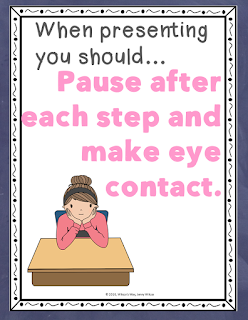
3. Pause after each step and make eye contact. This one goes hand in hand with speaking at a reasonable pace. I can't tell you how many times I have had students completely lose everyone in the room (even me!) trying to explain their method. I find that there are two common reasons why kids get lost during another student presentation. One reason is that presenters give all of their steps at one time, and this puts everyone's brain on overload if they're still trying to process the second step, and the presenter is talking about the fifth step! The other common reason that happens is that a student doesn't understand something early on, so they either stop understanding or stop listening.
For these reasons, I teach kids that they need to pause after each step and make eye contact. This way, the listeners have a chance to process what you're saying as you pause. Hopefully, when you make eye contact it will be obvious if the people that you're talking to are lost!
I also find that it is very important to tell my class that this helps everyone....including me. I like having my students see that I also have to ask people to slow down, repeat a step, or answer a question to clarify their method. I think it is so important to normalize the process of understanding, and that needing someone else to slow down does not make you "dumb".
4. Ask for questions from the class. This one closely follows the last one. If you are pausing after each step, it is a natural time to let people ask questions. Hopefully when you continue, there is a better chance for your audience to understand what you're saying now. Also, if you have more chances for questions, there is a better chance more people will understand by the end.
5. Show visuals. This can help for different kinds of learners. It is also helpful to have it as a reference throughout the presentation.
At the beginning of the year, we spend time talking about and practicing these norms. In my next post, I'll look at the other side of the discussion: listening norms.
1. Speak loudly enough for everyone to hear. This one is pretty obvious, and yet we all have students that seem to speak at a whisper.
2. Speak at a reasonable pace. Again, seems obvious, but I know that students really seem to struggle with this for a variety of reasons. For one thing, when kids get excited, they often rush when they are talking! Unfortunately, that can really get in the way of other people getting understanding what you're so excited to share with them.
3. Pause after each step and make eye contact. This one goes hand in hand with speaking at a reasonable pace. I can't tell you how many times I have had students completely lose everyone in the room (even me!) trying to explain their method. I find that there are two common reasons why kids get lost during another student presentation. One reason is that presenters give all of their steps at one time, and this puts everyone's brain on overload if they're still trying to process the second step, and the presenter is talking about the fifth step! The other common reason that happens is that a student doesn't understand something early on, so they either stop understanding or stop listening.
For these reasons, I teach kids that they need to pause after each step and make eye contact. This way, the listeners have a chance to process what you're saying as you pause. Hopefully, when you make eye contact it will be obvious if the people that you're talking to are lost!
I also find that it is very important to tell my class that this helps everyone....including me. I like having my students see that I also have to ask people to slow down, repeat a step, or answer a question to clarify their method. I think it is so important to normalize the process of understanding, and that needing someone else to slow down does not make you "dumb".
4. Ask for questions from the class. This one closely follows the last one. If you are pausing after each step, it is a natural time to let people ask questions. Hopefully when you continue, there is a better chance for your audience to understand what you're saying now. Also, if you have more chances for questions, there is a better chance more people will understand by the end.
5. Show visuals. This can help for different kinds of learners. It is also helpful to have it as a reference throughout the presentation.
At the beginning of the year, we spend time talking about and practicing these norms. In my next post, I'll look at the other side of the discussion: listening norms.
Subscribe to:
Posts (Atom)