
Showing posts sorted by relevance for query number talks. Sort by date Show all posts
Showing posts sorted by relevance for query number talks. Sort by date Show all posts
Friday, August 9, 2019
The Truth About Why You'll Love Number Talks
Have you heard about number talks? Are you on the fence about using number talks in your secondary math classroom? Maybe you think they might be ok, but you just don't think you have the time. Or maybe you don't know what a number talk is. Here are a few reasons to convince you to start using number talks in your math classroom tomorrow!


Sunday, August 11, 2019
Expert Planning Tips So You'll Love Number Talks
Number talks are beneficial for many reasons such as increased student engagement and number sense. The idea of a number talk is that you give students a problem to solve mentally. After giving time to solve the problem, students share their strategies. In my experiences (which you can read about here), students have lots of strategies and they are excited to share them.
If you're ready to start with number talks but not sure how to get started, here are a few things to consider.

If you're ready to start with number talks but not sure how to get started, here are a few things to consider.

Friday, May 29, 2020
How To Incorporate Number Talks in Distance Learning
Number talks have so many positive benefits, and they became a regular part of my classroom practice last year. I loved listening to my students' reasoning. The class time spent talking about and comparing strategies was well worth it.
However, when we shifted to distance learning, number talks were left by the wayside. As I consider next year, I know that I want number talks to be part of my teaching....whether online or (hopefully) in person. Here are some ideas of how I plan to use number talks if we go back to distance learning next year.
Ways to Use Number Talks with Distance Learning
However, when we shifted to distance learning, number talks were left by the wayside. As I consider next year, I know that I want number talks to be part of my teaching....whether online or (hopefully) in person. Here are some ideas of how I plan to use number talks if we go back to distance learning next year.
Ways to Use Number Talks with Distance Learning
Wednesday, August 21, 2019
Number Talks Modeled Multiple Ways: A Sure Fire Win!
If you are ready to start using number talks in your secondary math classroom, it's time to start thinking about how you will represent different strategies as students describe them. Personally, I like to use a variety of strategies including equations and visual models such as number lines and the area model. I feel that seeing the connections between different models can be very powerful for student growth. Here are a few reasons why I like using different representations of student strategies during number talks.

Tuesday, April 25, 2017
My NCTM Experience Part 3: Number Talks
When I saw sessions on number talks in the program, I knew that I wanted to go to one of them. We are planning a statewide book study for that will launch at the KATM conference next year, and the 4-10 book topic is on number talks. I've looked over a copy of the book that we're planning to use, so I know the basic idea of a number talk, but really wanted more information about putting it into action.
The idea of a number talk is fairly simple: you give students a problem and give them time to work the problem mentally....no pencil, no paper, no calculator. Then have a discussion about different ways that students solved the problem.

I was eager to try this idea in my classroom but somewhat reluctant to give up the time (isn't it always about time!). After attending a session on number talks in middle school, I was convinced that I wanted to make this part of my classroom. It seemed like a fairly easy idea to implement and one that could really be the center of lots of good discussions.
The session that I went to for math talks was a good introduction. We watched some video clips of the instructor doing number talks in a classroom and analyzed them. One of the most helpful things that we did was practice recording the thinking of our partners. Some of the ideas were easy to record, but others were a bit challenging. It was definitely helpful to spend some time thinking ahead about some of the best ways to record strategies to help students understand abstract representations.
So this week, I actually tried out a number talk for my warm up the last two days, and it was awesome! I will definitely be incorporating number talks into my warm-ups a couple of days a week from now on. The conversations we had around different ideas was phenomenal. My first piece of excitement came from the wide variety of hands that I had in the air of students eager to share their strategies....and some of them were kids that definitely do NOT make a habit of raising their hand. I have one kid that has been completely disengaged since spring break....like this kid's goal for state assessment was "To try and stay awake".....and he has had his hand in the air the last two days, sharing his ideas. Is that not amazing???!! :)
The other thing that was so exciting was the huge variety of strategies. The first problem I picked was 18 x 5, which I think was a suggestion I got from the session. It was a great problem and it led to lots of different strategies. Our discussion has included some of the following strategies:
The idea of a number talk is fairly simple: you give students a problem and give them time to work the problem mentally....no pencil, no paper, no calculator. Then have a discussion about different ways that students solved the problem.

I was eager to try this idea in my classroom but somewhat reluctant to give up the time (isn't it always about time!). After attending a session on number talks in middle school, I was convinced that I wanted to make this part of my classroom. It seemed like a fairly easy idea to implement and one that could really be the center of lots of good discussions.
The session that I went to for math talks was a good introduction. We watched some video clips of the instructor doing number talks in a classroom and analyzed them. One of the most helpful things that we did was practice recording the thinking of our partners. Some of the ideas were easy to record, but others were a bit challenging. It was definitely helpful to spend some time thinking ahead about some of the best ways to record strategies to help students understand abstract representations.
So this week, I actually tried out a number talk for my warm up the last two days, and it was awesome! I will definitely be incorporating number talks into my warm-ups a couple of days a week from now on. The conversations we had around different ideas was phenomenal. My first piece of excitement came from the wide variety of hands that I had in the air of students eager to share their strategies....and some of them were kids that definitely do NOT make a habit of raising their hand. I have one kid that has been completely disengaged since spring break....like this kid's goal for state assessment was "To try and stay awake".....and he has had his hand in the air the last two days, sharing his ideas. Is that not amazing???!! :)
The other thing that was so exciting was the huge variety of strategies. The first problem I picked was 18 x 5, which I think was a suggestion I got from the session. It was a great problem and it led to lots of different strategies. Our discussion has included some of the following strategies:
- 10*5 + 8*5 = 50 + 40 = 90
- 20*5 - 2*5 = 100 - 10 = 90
- (2*9)(5) = (2)(9*5) = 2(45) = 90
- (9*2)(5) = (9)(2*5) = 9(10) = 90
- 18 + 18 + 18 + 18 + 18 = 90
- 18 + 18 = 36, 36 + 36 = 72, 72 + 18 = 90
- counting up by multiples of 5
- counting up by multiples of 5, starting at 60 since they knew that 5 x 12 -= 60
I was very pleased with this many strategies coming to the surface on our very first attempt! And this one number talk brought up important ideas and vocabulary such as distributive property, associative property, and the commutative property.
So on day 2, I chose the problem 15 x 8. I intentionally chose a problem that had an even number and a multiple of 5, hoping to encourage rearrangement of factors to get to a multiple of 10. Again, I had tons of hands in the air and a wide variety of strategies. As with the first problem, I had a variety of strategies used. The most common ones were probably these:
- 10*8 + 5*8 = 80 + 40 = 120
- 15 * 2 = 30, 30 x 2 = 60, 60 x 2 = 120
- 15 + 15 = 30, and there are four groups of 2 15s, so you would have 30 x 4 = 120
My favorite one, however, was the very last one of the day. It came from a student that had already shared one strategy, and as he looked at the wall, he said, "Or you could use a clock. The 15 is like 15 minutes, and there is 4 of those in an hour. So it would take 2 hours to have 8 sets of 15 minutes, and I know that 2 hours is 120 minutes." I mean seriously.....could I have asked for anything more! What awesome, creative reasoning!
So, after 2 short days, I am quickly a believer in number talks in the middle school classroom. I can definitely see a ton of advantages to making these a part of my classroom from day 1 next year.
I've also gotten interested in using visual models during number talks. I think it is a great way to introduce students to some mental models that can be very powerful, such as the area model, number lines, money and clocks (as mentioned above!). If number talk slides that already visual models of several strategies might be helpful, check these out in my store!
I've also gotten interested in using visual models during number talks. I think it is a great way to introduce students to some mental models that can be very powerful, such as the area model, number lines, money and clocks (as mentioned above!). If number talk slides that already visual models of several strategies might be helpful, check these out in my store!
Sunday, October 8, 2017
Beginning of Class Routine Revamp: Part 2
A couple of weeks ago, I wrote about my new beginning of class routine: Wonder Monday, Two Way Tuesday, What's the Question Wednesday, Number Talk Thursday and Quick Draw Friday. This routine has gotten me through the first quarter of the year, and I have really enjoyed each of these days. I have enjoyed the different aspects of math that they encourage.....from geometry with Quick Draw to number sense with Number Talks and Two Way Tuesday. I've enjoyed seeing the power of What's the Question Wednesday both as a formative assessment tool, and to encourage creativity. Wonder Monday has sparked many great discussions, and even led a student to actually find the cost of filling a pool with jello....which was over $800 by the way!

But, I have also discovered some other cool resources that would also make great warm-ups. So I'm thinking I may introduce some of these other ideas from time to time. Here is my next set of ideas for an interesting way to start class.


But, I have also discovered some other cool resources that would also make great warm-ups. So I'm thinking I may introduce some of these other ideas from time to time. Here is my next set of ideas for an interesting way to start class.
- Math at Work Monday: I found this awesome website that has a section called Math at Work Monday. There are interviews with all kinds of people about how they use math at their jobs. What a great way to open my kids eyes to the power of what we're learning! I also found out about this cool Chrome extension called Insert Learning that lets you put questions, videos and other content into a website for students to access. Tomorrow, I'm planning my warm up to be Math at Work Monday while I use Insert Learning!
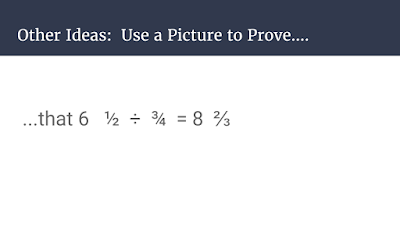
- Use a Picture to Prove....: I was inspired by Jo Boaler's book Mathematical Mindsets for this idea. One of the ways that she recommends opening up a task to make it richer is to have students make a visual to go with it. I think this could have some real power to get at the heart of some difficult topics...like fractions!

- Would You Rather?: The idea is to give a choice like, Would you rather have a 1 foot stack of quarters or a $20 bill? I got this idea from the Would You Rather Math website, which has lots of great examples. However it's also really easy to come up with your own!

- What's the Story (version 1): I was so excited when I found the Graphing Stories website. This is sooooo cool, and I think the practice graphing would be so helpful and spark tons of great discussion!
- What's the Story (version 2): Find a graph, and have the students write the action that matches the story. Seems like this would alternate well with What's the Story version 1....going back and forth between seeing the action and then making the graph, vs. seeing the graph and describing the action.

- What's the Story (version 3): Find some data, and have students draw the conclusion or decide on the caption from it. We are in a world with so much data, but how much practice do we give kids at deciding what the data is actually telling us?
If you would like a template for these routines, click here for a simple Google Slides that has a slide for each idea (including the ideas in my Beginning of Class Routine Revamp: Part 1 post!)
Wednesday, June 14, 2017
Beginning of Class Routine Revamp
At NCTM, I got several ideas that I wanted to incorporate into my beginning of class routine, and I've been finding others as well. Here is my beginning of class routine for next year.

Wonder Monday: This idea is the culmination of a lot of reading and listening that I have been doing. Jo Boaler's Mathematical Mindset, as well as her growth mindset course have really opened up my eyes to the need for math to be an open and creative field. I've also been reading "Becoming the Math Teacher You Wish You'd Had", which talks about the importance of a "notice" and "wonder"...what do kids notice about a problem? What do they wonder about?
So this is my thought for how to get kids thinking creatively, as well as how math is woven in to so much that we do. My plan here is to find a crazy or interesting picture each week, and just letting the kids start to wonder about it. I think it will get their creative juices flowing, and hopefully start to see math as an open subject, with a place for interesting questions. I think this will be a fun way to start each week!

Two Way Tuesday: This one came directly from a wonderful session I went to at NCTM. The idea of the two-way puzzle is that you add going horizontally and vertically. I think the puzzle aspect of this will keep kids engaged, and I can see it being useful for all kinds of review content....fractions, decimals, whole number, integers, and combining like terms are the first few that come to mind.
What's the Question Wednesday: I got this idea from another blog I was reading. Basically, you give the answer, and the kids brainstorm what the question might have been. Again, I think this could encourage creativity and help kids see that there are all kinds of ways to get to any given answer.

Number Talk Thursday: This is something else that I've been reading about, and something that I heard about at NCTM. The idea is basically that you give kids a problem to solve mentally, and then you let kids share their strategies for how they solved the problem. I tried this out a couple of times toward the end of last year, and I was amazed at what a great use of class time it was. The kids were highly engaged, and had tons of great strategies. It also allowed for great discussion as we compared strategies.

Quick Draw Friday: This is also something that I got at NCTM. The idea behind it is that you give kids a short look at a geometric drawing, and they try to reproduce it. Then you give them one more look, and a chance to revise. Then let kids share their vision for how they saw the picture, and how they re-drew it. I think this one can really lead to some great vocabulary, and my artistic kids will love it! The idea comes from this e-book.

So these are the ideas that I plan to use next year. If you would like a copy of the Google Slides shown above for this beginning of class routine, click here.
One other idea that I would also love to incorporate (but ran out of days!) would be to have a day each week dedicated to looking at a graph and focusing on what story it tells. I think this is really important as we live in a world surrounded by data, with graphs everywhere trying to convince us of one point or another. I may try to work this in somehow to my routine, but I can't decide what to give up! Why is there always more to do than there is time?????
What routines do you use at the beginning of class that you love?
NOTE: I did a part 2 to this part with even more ideas. Click here to see the rest!

Wonder Monday: This idea is the culmination of a lot of reading and listening that I have been doing. Jo Boaler's Mathematical Mindset, as well as her growth mindset course have really opened up my eyes to the need for math to be an open and creative field. I've also been reading "Becoming the Math Teacher You Wish You'd Had", which talks about the importance of a "notice" and "wonder"...what do kids notice about a problem? What do they wonder about?
So this is my thought for how to get kids thinking creatively, as well as how math is woven in to so much that we do. My plan here is to find a crazy or interesting picture each week, and just letting the kids start to wonder about it. I think it will get their creative juices flowing, and hopefully start to see math as an open subject, with a place for interesting questions. I think this will be a fun way to start each week!

Two Way Tuesday: This one came directly from a wonderful session I went to at NCTM. The idea of the two-way puzzle is that you add going horizontally and vertically. I think the puzzle aspect of this will keep kids engaged, and I can see it being useful for all kinds of review content....fractions, decimals, whole number, integers, and combining like terms are the first few that come to mind.
 |
| In this example, the missing box in the top row would be 22, since -8 + 22 = 14. The bottom left square would be -5, since -8 + 3 would be -5. From there, you can fill in the rest of the squares. |

Number Talk Thursday: This is something else that I've been reading about, and something that I heard about at NCTM. The idea is basically that you give kids a problem to solve mentally, and then you let kids share their strategies for how they solved the problem. I tried this out a couple of times toward the end of last year, and I was amazed at what a great use of class time it was. The kids were highly engaged, and had tons of great strategies. It also allowed for great discussion as we compared strategies.

Quick Draw Friday: This is also something that I got at NCTM. The idea behind it is that you give kids a short look at a geometric drawing, and they try to reproduce it. Then you give them one more look, and a chance to revise. Then let kids share their vision for how they saw the picture, and how they re-drew it. I think this one can really lead to some great vocabulary, and my artistic kids will love it! The idea comes from this e-book.

So these are the ideas that I plan to use next year. If you would like a copy of the Google Slides shown above for this beginning of class routine, click here.
One other idea that I would also love to incorporate (but ran out of days!) would be to have a day each week dedicated to looking at a graph and focusing on what story it tells. I think this is really important as we live in a world surrounded by data, with graphs everywhere trying to convince us of one point or another. I may try to work this in somehow to my routine, but I can't decide what to give up! Why is there always more to do than there is time?????
What routines do you use at the beginning of class that you love?
NOTE: I did a part 2 to this part with even more ideas. Click here to see the rest!
Subscribe to:
Posts (Atom)